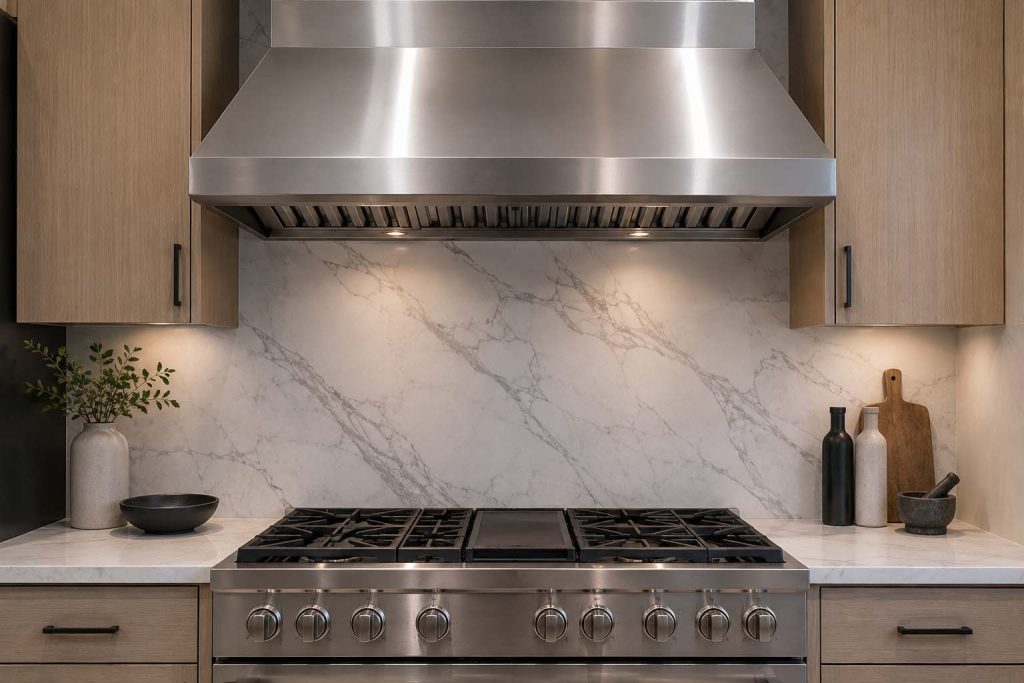
A GE Monogram vent hood usually stops working for one of five reasons:
- Check for lost power at the outlet, breaker, or fuse.
- Inspect the control switch or touch panel for failure.
- Clean a grease-clogged filter that is blocking airflow.
- Test the blower motor, which can burn out over time.
- Suspect the control board when lights work but the fan does not.
A dead or weak range hood is more than an annoyance in a GE Monogram kitchen. It lets grease, smoke, and moisture settle on your cabinets and other built-in appliances. The good news is that many hood problems trace back to a simple filter or power issue you can check yourself.
This guide walks you through each cause in plain order, from the easy fixes to the parts that need a pro. You will learn how to tell a filter problem from a motor problem, what is safe to touch, and when a technician saves you time and money.
Why Your GE Monogram Vent Hood Stops Working
A vent hood has three jobs: pull air through a filter, spin a blower motor, and push that air out through a duct. When any one of those links breaks, the hood seems dead or weak. Your task is to find which link failed.
GE Monogram Repair Expert is a specialist appliance-repair service for GE Monogram built-in kitchens. Its certified technicians work from a diagnostic-first, written-quote process and fit OEM parts. That matters here, because a hood fault can look like a motor when it is really a switch or a filter.
Work from cheapest to most complex. Power and filters cost nothing to rule out. Motors and boards cost the most, so you confirm them last.
Start Here: Power and Controls
Before you blame the motor, prove the hood is getting power. This step takes two minutes and saves a needless service call.
No power at all: nothing lights up or runs
Check the wall switch, the breaker, and any fuse first. Many Monogram hoods share a circuit with the range or cooktop, so a tripped breaker can kill both at once. Reset the breaker fully to off, then back to on.
If your hood plugs into an outlet inside the cabinet above it, test that outlet with another device. A loose plug or a dead GFCI outlet is a common and easy fix. Press the reset button on any nearby GFCI.
Still nothing? The internal wiring or the control board may have failed. That is a technician job, covered further down.
Controls or switch not responding
If the lights work but the fan buttons do nothing, the control switch or touch panel is the likely fault. On mechanical models, a worn rocker or rotary switch stops sending power to the motor. On electronic models, the touch panel can lose its signal.
Try a hard reset first. Cut power at the breaker for one full minute, then restore it. This clears many electronic glitches on Monogram hoods.
If the reset fails, the switch or panel needs replacement with an OEM part. Note that “range hood lights not working” is a separate issue with its own fixes — see our guide on GE Monogram range hood lights not working.
When the Fan Won’t Run: Motor and Board
If power reaches the hood and the switch responds, the problem sits deeper. Now you look at the blower motor and the control board.
Blower motor failure
The blower motor is the part that actually moves air. A failing motor gives clear warning signs. Listen for a humming sound with no spinning, a loud grinding, or a fan that starts then stops.
A motor that hums but will not turn often has a seized bearing or a bad capacitor. A motor that is silent and dead may have an open winding. Both faults confirm with a multimeter, which reads whether the motor windings still carry current.
Motor replacement means removing the hood housing and disconnecting wiring. On built-in Monogram units, tight clearances make this awkward. A technician with the correct OEM motor finishes it safely.
Control board faults
The control board is the brain that tells the motor what to do. When lights work but the fan stays dead across every speed, the board is a prime suspect. A board can fail from grease buildup, heat, or a power surge.
You cannot test a board reliably at home without the wiring diagram. Guessing here often means buying the wrong part. This is the point where a diagnostic-first visit pays for itself.
When Airflow Is Weak: Filters and Ducting
Sometimes the fan runs but the hood pulls almost no air. That points to a blockage, not an electrical fault. Two things cause it: a dirty filter or a blocked duct.
Grease filters
The grease filter is the metal mesh panel under the hood. A grease filter is a washable screen that traps cooking oils before they reach the motor. When it clogs, airflow drops and the motor strains.
Slide the filter out and wash it in hot, soapy water or run it through the dishwasher. Do this monthly in a busy kitchen. A clean filter often restores full suction with no repair at all.
If your model uses a charcoal filter for recirculating mode, replace it rather than washing it. Charcoal filters absorb odor and cannot be cleaned.
Ductwork and damper
If the filter is clean but airflow is still weak, check the duct. The damper is a flap that opens when the fan runs and closes when it stops. A stuck damper or a bird nest in the outside vent chokes the whole system.
Look at the exterior wall or roof cap where the duct exits. Clear any lint, debris, or blockage you can safely reach. Deeper duct problems inside the wall need a pro.
Lights Work but the Fan Won’t Run
This exact symptom confuses many owners, so it deserves its own note. Lights and fan run on separate circuits inside the hood. Working lights simply prove the hood has power.
That narrows the fault to three parts: the fan switch, the blower motor, or the control board. Run the reset above, then check the switch, then suspect the board. If you are not comfortable opening the housing, stop here and book a visit.
Safety First: What to Check Before You Touch Anything
Cut the power before you open any part of the hood. Electrical shock is the main risk with any range hood repair, and Monogram hoods carry live voltage right up to the switch.
Switch off the breaker, not just the wall switch. Confirm the fan and lights are truly dead before you remove a single screw. If your hood sits over a gas range, also make sure the burners are off and cool.
Grease is flammable, so never run a hood with a heavily clogged filter over an open flame. If you smell gas at any point, leave the area and call for help before doing anything else.
When to Call a GE Monogram Pro
Call a technician when the fix involves the blower motor, the control board, internal wiring, or in-wall ducting. These repairs need the right OEM part, a wiring diagram, and safe handling of live voltage. Guesswork here risks the part and your safety.
A GE Monogram vent hood is built into a premium kitchen, so a wrong aftermarket part can cost more than it saves. Certified technicians diagnose the true fault first, then give you a written quote before any work starts. That way you decide with the full picture in front of you.
Book a GE Monogram vent hood diagnosis to get the fan running again without trial-and-error part swaps.
Frequently Asked Questions
Why is my GE Monogram vent hood not working?
A GE Monogram vent hood most often fails from lost power, a bad control switch, a clogged grease filter, a worn blower motor, or a faulty control board. Start by checking the breaker, outlet, and filter, since those cost nothing to rule out. Motor and board faults need a technician and an OEM part.
Why does my GE Monogram range hood fan not turn on but the lights work?
Working lights but a dead fan means the hood has power, so the fault sits in the fan switch, the blower motor, or the control board. Lights and the fan run on separate circuits inside the hood. Try a one-minute breaker reset first, then have a technician test the switch, motor, and board.
How do I reset a GE Monogram vent hood?
Reset a GE Monogram vent hood by switching off its breaker for one full minute, then switching it back on. This clears many electronic control glitches that freeze the fan or touch panel. If the hood still will not run after a reset, the switch, motor, or control board likely needs service rather than a reset.
Can I clean a GE Monogram vent hood filter myself?
You can clean a GE Monogram metal grease filter yourself by sliding it out and washing it in hot, soapy water or the dishwasher. Do this monthly in a busy kitchen to keep airflow strong. If your model uses a charcoal filter for recirculating mode, replace it instead, because charcoal filters cannot be washed.
Is it worth repairing a GE Monogram vent hood?
Repairing a GE Monogram vent hood is usually worth it, because these built-in units are matched to a premium kitchen and cost far more to replace than to fix. Simple filter, switch, and power fixes are low cost. For motor or board faults, a written quote from a certified technician tells you the true repair cost before you commit.
Keep Your Monogram Kitchen Running
A GE Monogram vent hood rarely dies without a reason you can trace. Check power and the filter first, listen for motor warning signs, and reset the controls before you assume the worst. Those steps solve a large share of hood complaints in minutes.
When the fault points to the motor, board, or ducting, bring in a pro rather than swapping parts blindly. Contact GE Monogram Repair Expert for a diagnostic-first visit and a written quote, and get clean, quiet airflow back over your range.