
A GE Monogram refrigerator acting up usually traces back to one of six faults: it is not cooling, the freezer is not freezing, it is leaking water, making noise, not making ice, or it needs a reset. This guide points you to the right fix for each symptom, and to when a technician should take over.
This troubleshooting guide walks you through the most common GE Monogram refrigerator faults and sends you to the exact fix for each one. GE Monogram Expert repairs only GE Monogram and GE Profile appliances across eight U.S. markets, using certified technicians and OEM parts. Match your symptom below, run the quick checks that solve many cases, and learn when a built-in fault needs a pro. If you already know it is beyond a DIY fix, you can book a diagnostic now.
Start with your symptom
Six symptoms cover almost every GE Monogram refrigerator service call. Find yours below, then follow the linked guide for the full diagnosis.
Refrigerator not cooling
If the fridge runs but the food is warm, the cause is usually airflow, dirty coils, or a failed fan, rarely the compressor. Work through our refrigerator not cooling checks first.
Freezer not freezing or frosting over
A freezer that runs warm or ices over points to the defrost system, door seals, or temperature control. See our freezer not freezing guide.
Refrigerator leaking water
Water on the floor or inside the cabinet usually comes from a clogged defrost drain, the water line, or the filter housing. Our refrigerator leaking water guide shows which causes need a technician.
Refrigerator making noise
Buzzing, humming, and rattling each point to a different part, from the condenser fan to the compressor. Match the sound in our refrigerator making noise guide.
Ice maker not making ice
No ice usually traces to the water supply, a clogged filter, freezer temperature, or the ice maker module. Start with our ice maker not working guide.
Refrigerator needs a reset
After a power outage or an error code, a reset clears many faults, but not a mechanical one. See how to reset your refrigerator and what a reset cannot fix.
Quick checks that fix many faults
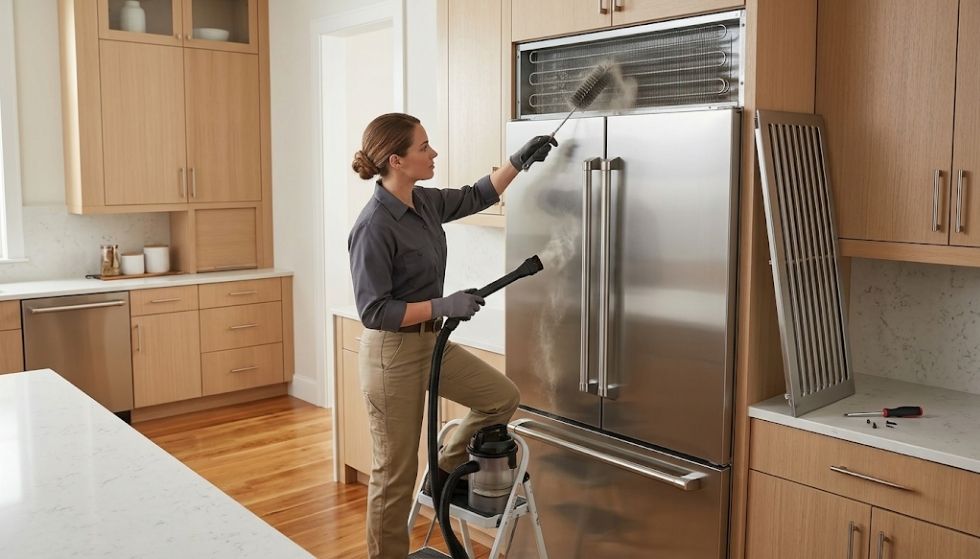
Dirty condenser coils are the single most common cause of poor cooling, and they should be cleaned every 6 to 12 months. Before you assume the worst, run these four checks that solve a large share of calls.
- Power and mode: confirm the interior light comes on, and make sure the unit is not in showroom or demo mode, which stops cooling on purpose.
- Temperature: set the fridge near 37°F and the freezer at 0°F, then give it 24 hours to recover after any change.
- Airflow: keep interior vents clear and leave about 1 inch of clearance behind the cabinet so the unit can shed heat.
- Door seals: check the gasket for gaps or tears that let warm air leak in.
When to call a GE Monogram technician
Sealed-system, compressor, and control-board faults need a certified technician and specialized tools. If the compressor runs nonstop, the fridge trips the breaker, you see oily residue near the coils, or the checks above change nothing, stop there.
These built-in units box the components into cabinetry, so a safe repair means the right parts and access. Book our refrigerator repair service and a technician will diagnose the exact fault on site.
Frequently asked questions
What are the most common GE Monogram refrigerator problems?
The most common GE Monogram refrigerator problems are poor cooling, a warm freezer, water leaks, unusual noise, and no ice. Many of these start with dirty condenser coils, blocked vents, or worn door seals. Deeper faults, like a failed fan motor or sealed-system leak, need a technician to diagnose and repair safely.
Can I fix a GE Monogram refrigerator myself?
You can safely handle the basic checks yourself: temperature settings, cleaning the condenser coils, clearing vents, and inspecting the door seals. Leave fan motors, the defrost system, refrigerant, and control boards to a certified technician. On a built-in worth thousands, a wrong part or a damaged line costs far more than the original fault.
How often should I clean the condenser coils?
Clean the condenser coils every 6 to 12 months, or twice a year if you have pets or a dusty kitchen. On built-in Monogram models, the coils are usually reached through the top or lower front grille rather than the back. Clean coils keep the compressor from overworking and extend the fridge’s life.
The bottom line
Most GE Monogram refrigerator faults start small: coils, vents, seals, or a setting. Match your symptom, run the quick checks, and only the mechanical faults should reach a technician.
When a fault is past a DIY fix, get a firm diagnosis before any work. Schedule your GE Monogram diagnostic and we will match you to the right technician.