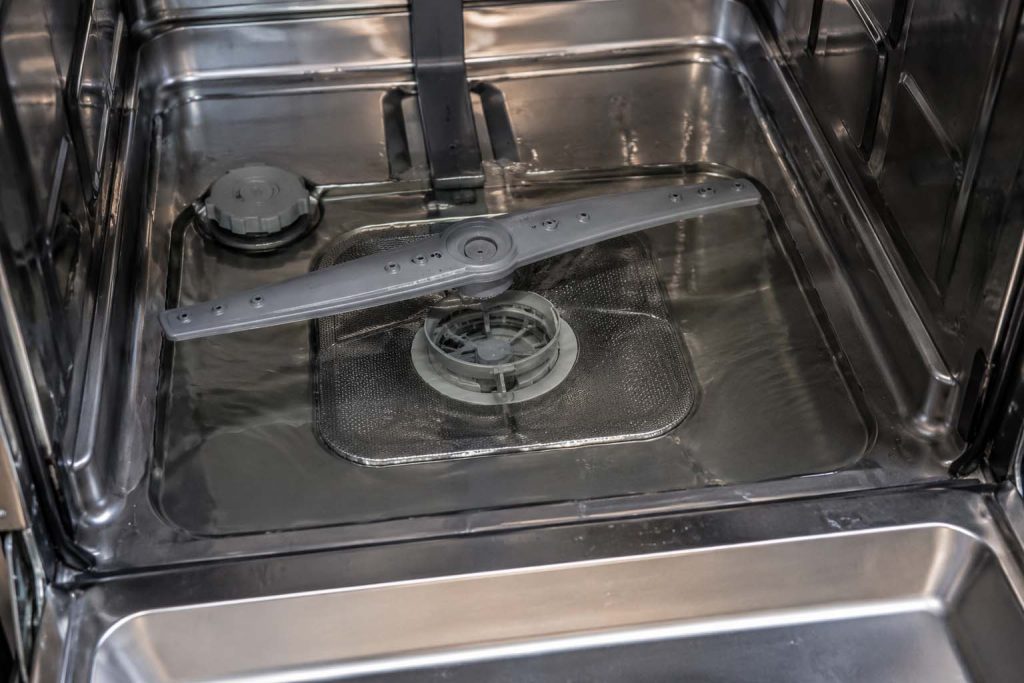
A GE Monogram dishwasher that won’t drain is almost always blocked somewhere between the filter and the drain pump. The six usual causes, from most to least common, are a clogged filter, a backed-up garbage disposal, a kinked drain hose, a blocked air gap, a stuck check valve, and a failed drain pump.
Standing water in the bottom of the tub looks alarming, but most GE Monogram drainage problems are a simple blockage you can clear in under an hour. Water leaves the dishwasher through a chain of parts, and a clog anywhere along it leaves dirty water behind. This guide walks the six causes in the order a technician checks them, from the easy filter clean to the drain pump. GE Monogram Repair Expert services built-in GE Monogram dishwashers with OEM parts and a diagnostic-first written quote. Two quick steps come first.
Before you start: reset and bail the water
An interrupted cycle is the simplest cause of all. If someone opened the door or the power blinked, the cycle may have stalled with water still inside, so reset the dishwasher and run a short cycle first.
If water remains, remove it before you work. Scoop out standing water with a cup and towels, or use a wet/dry vacuum, so you can see and reach the filter.
One safety rule matters here. Cut power at the breaker or wall switch before you reach into the pump or remove any panel, because the dishwasher mixes water and electricity.
The 6 causes of a GE Monogram dishwasher not draining
Work through these in order. The first three solve most cases and cost little to nothing, while the last three move toward a service call (Today’s Homeowner).
1. Clogged filter
The most common reason a dishwasher won’t drain is a clogged filter that traps food and grease until water can’t pass. Lift out the bottom rack, twist the filter counterclockwise, rinse it under hot water, scrub the mesh, and reinstall it.
2. Backed-up garbage disposal
Built-in dishwashers usually drain through the kitchen disposal, so a clog or a forgotten knockout plug there blocks the dishwasher too. Run the disposal to clear it, and if you recently installed a new disposal, confirm the drain knockout plug was removed.
3. Kinked or clogged drain hose
The drain hose can pinch behind the cabinet or collect grease and soap scum inside. Check that the hose isn’t bent, then disconnect it and flush it with hot water; a hose that doesn’t loop high under the sink can also let water siphon back.
4. Blocked air gap
If your sink has an air gap — the small chrome cylinder on the counter — debris inside it stops the dishwasher from draining. Twist off the cap, pull the cover, and clear any gunk with a tube brush.
5. Stuck check valve or drain solenoid
The check valve stops dirty water from flowing back into the tub, and a stuck valve causes water to drain and then return. If water gurgles back in or drains slowly, the valve or its solenoid likely needs cleaning or replacement, often a technician job.
6. Failed drain pump
If the first five check out, the drain pump is the culprit. A dishwasher that hums but won’t drain, or makes a grinding or squealing noise, usually has a jammed or failed pump impeller (Roto-Rooter). Broken glass and seeds are common impeller jammers.
When to call a GE Monogram technician
The first four causes are owner-friendly, but the check valve and drain pump are not. Both sit deep in the machine, involve electrical connections, and need a multimeter to test correctly.
A drain pump replacement is the priciest of these fixes, while the filter, hose, and disposal clears cost little — see the GE Monogram dishwasher repair cost guide for the breakdown. GE Monogram Repair Expert quotes the part and labor before any work begins, so a $5,000 panel-ready unit isn’t opened on a guess. If the dishwasher also won’t start, see our won’t-start guide.
Frequently asked questions
Why is my GE Monogram dishwasher full of water at the bottom?
Standing water means the drain path is blocked. The most likely spots, in order, are a clogged filter, a backed-up garbage disposal, and a kinked drain hose. Clear those three first. If water remains after a fresh cycle, the check valve or drain pump is the next suspect and usually needs a technician.
How do I clean the filter when the dishwasher won’t drain?
First remove the standing water with a cup, towels, or a wet/dry vacuum so you can reach the filter. Lift out the bottom rack, twist the cylindrical filter counterclockwise, and pull it up. Rinse it under hot water, scrub away trapped food, then reinstall it and run a test cycle.
My GE Monogram dishwasher hums but won’t drain — what’s wrong?
A humming sound with no drainage usually points to the drain pump. The motor is trying to run, but a jammed impeller or a failed pump can’t push the water out. Broken glass or seeds often jam the impeller. This is a technician-level fix that involves removing and testing the pump.
Should I run my GE Monogram dishwasher if it has standing water?
You can run one empty cycle, or use the cancel and drain function, to see if the machine clears itself. If the water stays, stop running cycles and check the filter, air gap, and disposal. Repeated cycles won’t fix a blockage and can leave odors and residue behind.
Get your GE Monogram dishwasher draining again
Most GE Monogram drainage problems trace to a clogged filter, disposal, or hose — fixes that take about an hour and little money. Work the six causes in order, and reset the cycle and bail the water before you start. When the trail leads to the check valve or drain pump, book a GE Monogram dishwasher repair visit for a diagnostic-first written quote with OEM parts, or reach the team through the contact page before the standing water turns into an odor problem.