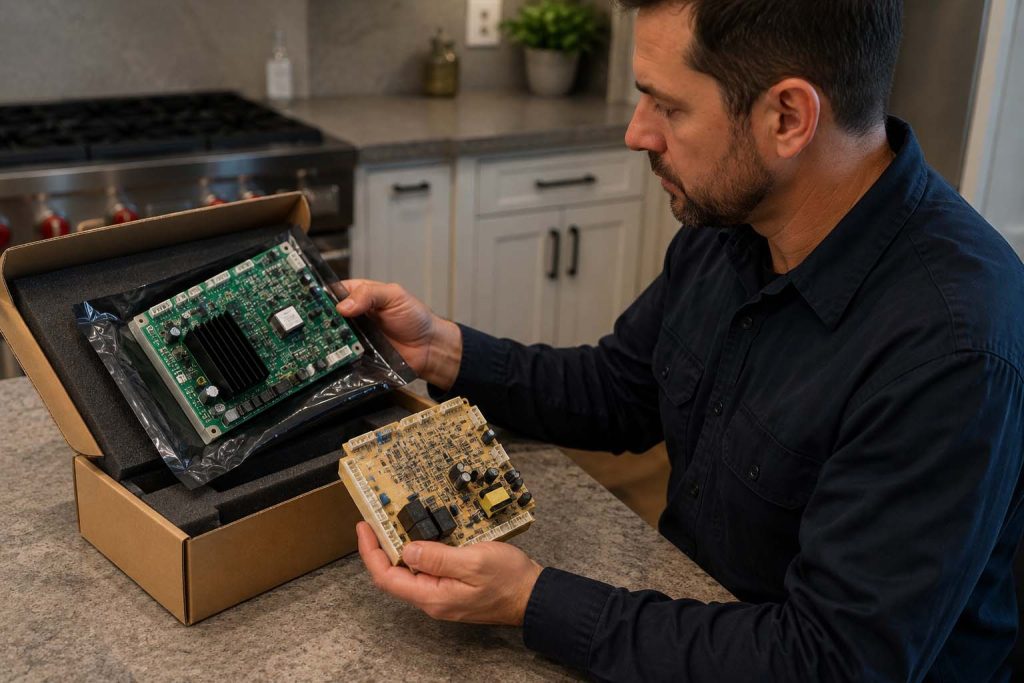
OEM parts for GE Monogram appliances are components made or approved by GE Appliances and sold under GE part numbers. On built-ins that cost $5,000 to $25,000+, genuine parts protect fit, warranty coverage, and serviceability. Aftermarket parts belong only in low-risk spots — accessories and cosmetic items — never in sealed systems, control boards, or gas components.
That is the short version. The longer version explains why the stakes are different for a Monogram column refrigerator than for a $600 freestanding fridge, and where a cheaper part is genuinely fine. GE Monogram Repair Expert is a repair service specializing in GE Monogram and GE Profile built-in appliances across California, Washington, and Massachusetts, and its technicians install genuine GE Monogram OEM parts on every covered repair. If you already have a failed part in hand, you can request a diagnostic visit and skip the guesswork.
What counts as an OEM part for a GE Monogram appliance
An OEM (original equipment manufacturer) part is the exact component GE specifies for your model — either the part installed at the factory or GE’s updated replacement for it. Genuine GE part numbers use family prefixes, such as WR for refrigeration, WB for cooking, and WD for dishwashers, and every one is searchable by model number at GE’s official parts site.
Everything else falls into three tiers. Aftermarket parts are third-party components built to imitate the original. Generic parts are loose equivalents — a “universal” igniter or inlet valve sized to fit many brands. Counterfeits are the worst tier: packaging and labels that imitate GE’s, sold mostly through third-party marketplace listings.
The distinction matters more for Monogram than for most brands. Monogram shares GE’s part-number system, but many components — door gaskets, custom-panel hinges, inverter boards — are specific to the built-in line and have no true generic equivalent.
Why the OEM decision is bigger on a $5K–$25K built-in
GE Monogram built-ins run roughly $5,000 to $25,000+ installed, so a $50 part decision carries appliance-level consequences. Three risk areas do most of the damage.
Exact fit, flush installs, and serviceability
Built-ins are installed to cabinetry tolerances measured in millimeters. A door gasket that is 2 mm proud, or a hinge with slightly different geometry, can leave a column refrigerator door misaligned against its panel. The appliance then fights its own installation: sweating seams, frost buildup, and doors that drift out of alignment.
Serviceability is the quieter cost. When the next technician opens your appliance and finds an unlabeled generic board, diagnosis slows down because the service documentation no longer matches what is inside the machine.
Sealed-system repairs: no place for substitutes
The sealed system — compressor, condenser, evaporator, and the refrigerant lines connecting them — is the heart of a Monogram column refrigerator or wine cooler. These repairs involve recovering refrigerant, brazing lines, and pulling a vacuum. A compressor that is “close enough” in capacity but wrong in specification can run hot, cycle badly, and take the new evaporator with it.
Monogram refrigeration uses inverter-driven compressors matched to their control electronics. Pairing a generic compressor with an OEM inverter board, or the reverse, is how a $400 repair becomes a $2,000 one. If your unit is warm and the compressor is suspect, start with a proper diagnosis — our GE Monogram refrigerator repair page covers how sealed-system visits work.
Control boards and induction electronics
Modern Monogram appliances are computers with heating elements attached. GE revises control boards mid-production, so two identical-looking models can take different boards depending on serial number. A correct board swap is usually a one-visit repair. A wrong or refurbished-mystery board means a failed install, a reorder, and a week or more of added downtime.
Induction is the clearest example. Monogram induction cooktops pair generator boards with specific coil assemblies; a mismatched board can throw persistent fault codes or fail under high-power loads. That is why our GE Monogram cooktop repair work runs on serial-specific board lookups, not visual matching.
What aftermarket parts actually do to your warranty
The honest answer is more nuanced than “aftermarket voids everything.” Under the Magnuson-Moss Warranty Act of 1975, a manufacturer cannot deny warranty coverage merely because a third-party part was used, per the FTC’s federal warranty law guide. What GE can do — and will — is deny coverage for damage an aftermarket part caused.
In practice that distinction has teeth. If a generic water valve leaks into the electronics bay, the valve is your problem and so is the flooded control board. Warranty terms vary by model and purchase date, so check your specific coverage before any out-of-pocket parts decision.
Extended warranties and home-warranty plans are usually stricter: many require documented repairs with manufacturer-approved parts. Keep your invoices — a paper trail showing OEM parts and a certified technician protects both warranty claims and resale conversations.
When aftermarket is acceptable — and where the line sits
Aftermarket is not a dirty word; it has a legitimate lane. Reasonable places to consider it:
- Cosmetic accessories: shelf bins, crisper covers, burner grates, and knobs where fit is simple and failure is harmless.
- Out-of-production parts: when GE has discontinued a component for an older Monogram unit, a quality aftermarket or refurbished OEM part can be the only path that avoids replacement.
- Non-appliance consumables: stainless cleaners, touch-up paint, and installation hardware.
The line sits at anything that touches gas, refrigerant, water under pressure, or the control system. Igniters, gas valves, compressors, inverter and control boards, water valves, and door gaskets on built-ins should be OEM every time.
Water filters deserve their own warning. AHAM’s “Filter It Out” campaign documents counterfeit refrigerator filters sold through third-party marketplace listings, and uncertified filters may not remove what their packaging claims. Use the filter model listed for your unit, and look for NSF/ANSI 42 and 53 certification on the box.
How to identify genuine GE parts — and how a certified tech sources them
Buying it yourself? Four checks separate genuine from generic:
- Buy from the source. GE’s official channels are GE Appliance Parts and the Monogram owners’ parts page, plus authorized distributors.
- Search by full model number, from the rating plate on the appliance — not by appearance or a marketplace title.
- Check the part number format. A GE-family prefix (WR, WB, WD) and a match in GE’s own lookup is the baseline test.
- Treat steep discounts as a flag. A “genuine” board at half the official price from an unnamed seller usually is not.
A certified technician does this one level deeper. Our technicians pull the model and serial number before ordering, because GE ties board revisions and substitutions to serial ranges — the correct part for your neighbor’s ZIC360 may be wrong for yours. Sourcing through authorized distribution also means the part arrives new, warrantied, and returnable, not pulled from a scrapped unit.
OEM vs. aftermarket cost: the honest math
Yes, OEM usually costs more at the register. But run the denominator: $100 saved on a generic board is less than 1% of a $12,000 column refrigerator’s value, and the generic option carries the failure risk. The expensive part of a repair is rarely the part — it is the second visit, the extended downtime, and the collateral damage when a substitute fails.
For real repair pricing on Monogram appliances — parts and labor by appliance type — see our GE Monogram appliance repair cost guide. And keep the tier honest: on a Monogram dishwasher, a regular-tier machine, big repairs deserve the standard repair-or-replace math rather than luxury-flagship logic — our repair or replace guide walks through it.
Parts strategy also shapes lifespan. Units maintained with correct parts are the ones that reach the upper end of the ranges in our guide to how long GE Monogram appliances last, and a routine like our GE Monogram maintenance checklist reduces how often you need parts at all.
Frequently asked questions
Are GE Monogram parts the same as regular GE parts?
Partly — Monogram shares GE’s part-number system, and some components overlap with GE Profile and Café models. But many Monogram parts are specific to the built-in line: custom-panel hinges, column-refrigerator gaskets, and inverter electronics have no mass-market equivalent. Always match parts by your full model and serial number, not by brand family alone.
Will an aftermarket part void my GE Monogram warranty?
Not automatically. Federal law (the Magnuson-Moss Warranty Act) bars manufacturers from denying coverage just because a third-party part was used. GE can, however, refuse to cover damage that an aftermarket part caused — and that exclusion is where owners get burned. For any appliance still under warranty, OEM parts installed by a certified technician are the safe route.
Where can I buy genuine GE Monogram parts?
Genuine parts are sold through GE Appliance Parts (geapplianceparts.com), the Monogram owners’ parts page, and authorized parts distributors. Search by the full model number from your appliance’s rating plate. Marketplace listings from unnamed sellers are where counterfeit and pulled parts concentrate, so treat unusually low prices on “genuine” parts as a warning sign.
How do I find the right part number for my Monogram appliance?
Start with the rating plate: inside the refrigerator compartment, on the oven door frame, or under the cooktop edge. Enter the full model number into GE’s parts lookup to see the exploded diagram and current part numbers. For control boards, have the serial number ready too — GE ties board revisions to serial ranges.
Are aftermarket water filters safe for a GE Monogram refrigerator?
They are the riskiest “cheap swap” owners make. Uncertified filters may not remove the contaminants their packaging claims, and counterfeits are common in marketplace listings, per AHAM’s Filter It Out campaign. Use the filter model GE lists for your unit and check for NSF/ANSI 42 and 53 certification. A leaking generic filter housing can also damage surrounding electronics.
The bottom line on Monogram parts
On a built-in appliance worth five figures, OEM parts are not an upsell — they are how the appliance keeps working like a Monogram. Save aftermarket for accessories; keep sealed systems, boards, gas, and water on genuine parts with a documented install.
If a part in your Monogram has failed, have a certified technician confirm the exact component and serial-correct part number before anything gets ordered. Book a diagnostic visit with GE Monogram Repair Expert and get a written quote with the genuine part specified — one visit, the right part, done.