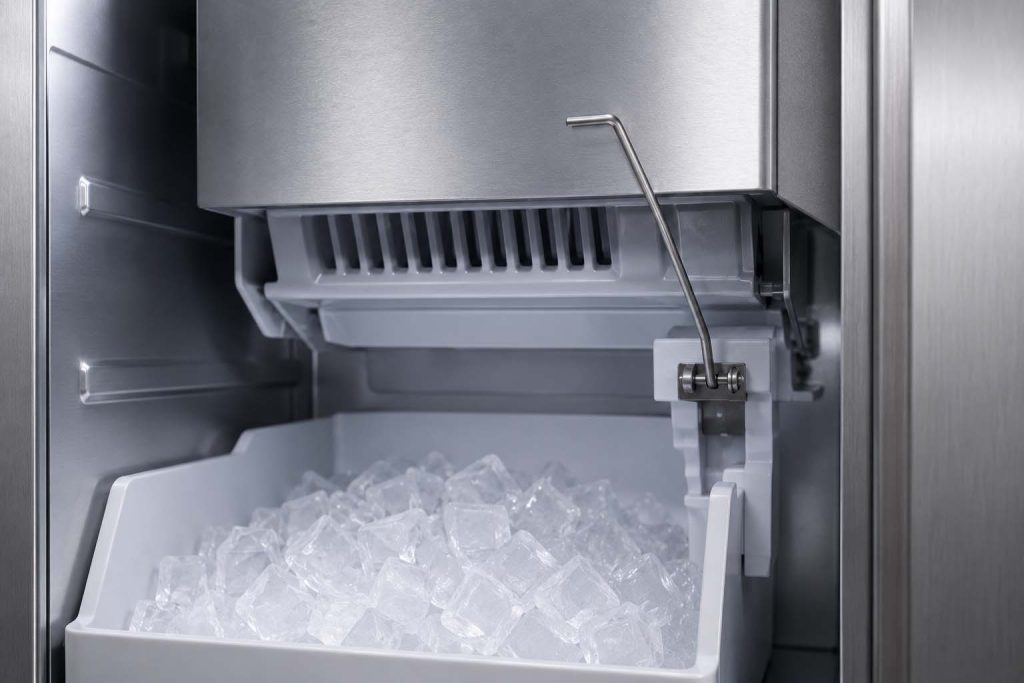
A GE Monogram ice maker that’s stopped working usually has one of five causes: the ice maker is switched off, the feeler arm is blocked, the fill tube has frozen, the water filter is overdue, or the inlet valve has failed. Owners can resolve the first four; valve and module faults need a technician.
Monogram refrigeration puts ice production in more places than most brands — door ice makers in French-door models, freezer-mounted units in built-in columns, and standalone nugget ice machines under the counter. The diagnostic logic is the same across all of them: confirm the unit is on and cold, then follow the water. This guide walks that path in order and marks where DIY should stop on a built-in. GE Monogram Repair Expert services Monogram and GE Profile built-ins across California, Washington, and Massachusetts; if the checks below don’t restore ice, book a diagnostic visit.
Check the switches and the temperature first
Start with the two-minute items. Monogram ice makers are shut off more often than they fail: a raised feeler arm or, on models with a power switch, a switch bumped during cleaning stops production silently. Anything in the bin pressing the arm up — a misplaced item, a pile of fused cubes — reads as “bin full.”
Then check temperature. Ice production slows and stops when the freezer runs above roughly 10°F, before food shows any sign. If the compartment is warm, the ice maker is the symptom, not the problem — start with our Monogram refrigerator troubleshooting guide and come back to ice once cooling is right.
Finally, confirm the household shutoff valve behind or under-sink is fully open, and remember the pace of the machine: a healthy ice maker produces a batch roughly every 90 minutes to 2 hours, and needs up to 24 hours to restart after power loss or repair.
No ice: follow the water path
An ice maker that cycles with an empty mold isn’t getting water. Three components sit on that path, in this order.
The water filter. GE recommends replacing the filter every 6 months, and a filter past its life restricts flow enough to starve the ice maker while the dispenser still runs. If production slowed before it stopped, this is the leading suspect — replace the cartridge and allow a full day of cycles.
The fill tube. The small tube feeding the mold can freeze into a plug after a temperature swing or a door left ajar. On Monogram built-ins the tube sits behind the ice maker at the top of the freezer section; a visible ice plug there confirms it. Thawing it is a careful job — heat and plastic panels don’t mix, which is one reason this fix often rides along with a professional visit.
The inlet valve. The solenoid valve at the supply connection opens on each fill call. Sediment in its screen or a failed solenoid means no water passes at all. It lives on the pressurized line at the back of a built-in column — testing and replacement are technician work.
Wrong ice: small, hollow, cloudy, or clumped
Partial production narrows the fault. Small or hollow cubes mean low flow — filter, valve screen, or household pressure. Cloudy or off-tasting ice points to an overdue filter or a stale bin; dump the bin, swap the filter, and judge the next two batches. Cubes fusing into a block mean partial melt and refreeze — a door seal or temperature-stability issue, not an ice maker fault.
Nugget-style Monogram ice machines add one more pattern: scale. In hard-water areas, mineral buildup slows the auger and cuts output long before anything breaks, and both descaling schedule and sanitization matter for these units. If your machine is an undercounter Monogram ice maker rather than an in-refrigerator unit, mention that when booking — it changes the parts on the truck. Our Monogram ice maker repair cost guide breaks out pricing for nugget and built-in units separately.
When it’s the module — and what a repair looks like
If water arrives, temperatures are right, and the mold still won’t fill or harvest, the ice maker assembly or its control board has failed. The module runs the harvest sequence — mold thermostat, heater, and ejector motor — and a fault in any one stops the whole cycle. On most Monogram units the assembly is replaced as a unit with the correct OEM part, in a single visit once diagnosed.
Two things justify calling early on a Monogram. Built-in columns are panel-integrated, and reaching the ice maker means an access sequence that’s easy to get wrong and expensive to force. And these are $5K–$25K appliances — the cost gap between a correct OEM repair and trial-and-error parts swapping is real. A reset is still worth one attempt first: power down at the breaker for one minute, restore, and give it 24 hours. Our guide to resetting a GE Monogram refrigerator covers when a reset helps and when it can’t.
Frequently asked questions
How do I reset a GE Monogram ice maker?
Lower the feeler arm fully, or power-cycle the refrigerator at the breaker for one minute, then allow up to 24 hours for production to resume. Monogram ice makers have no dedicated reset button. If production doesn’t restart after a power cycle and a day of runtime, the fault is in the water path or the module, and a reset won’t reach it.
Why did my GE ice maker suddenly stop working?
Sudden stops are usually mechanical — a raised or blocked feeler arm, an ice jam in the mold, or a frozen fill tube. Gradual decline before the stop points instead to the water path: an overdue filter, a clogging valve screen, or falling household pressure. The pattern of failure is the best first clue.
Why is the water dispenser working but not the ice maker?
Because they share a supply but split paths after the filter. A working dispenser with no ice means the blockage sits on the ice maker’s branch: the fill tube is frozen, the ice maker’s valve solenoid has failed, or the unit is switched off. It also rules out the household shutoff and (usually) the filter.
What are common problems with GE Monogram refrigerators?
The patterns we see most on Monogram refrigeration are ice maker faults, defrost-drain clogs that leak water, door-gasket wear on heavily used doors, and fan or damper issues that unbalance temperatures. Most are single-visit repairs. The troubleshooting parent guide on this blog walks through each symptom family in order.
Get your Monogram making ice again
Work the sequence — arm and switch, temperature, filter, fill tube — and give the machine 24 hours after any change. If the bin stays empty, the valve or module needs testing, and on a built-in column that’s a job for someone who knows the panel access sequence. Schedule Monogram ice maker service with GE Monogram Repair Expert — certified technicians, OEM parts, and single-visit fixes for most ice maker faults across our California, Washington, and Massachusetts service areas.